
ELLIE’S 2025 FESTIVAL BLOG
Saturday, 8 November
The next morning, I was back at the Jubilee Hall for ‘Running amok in the house of phrases’, a reading and interactive workshop by Sophie Herxheimer. This energetic session encouraged me to play – to lean into cutting up words, pages, colours, to create my own collage work. Sophie embodied the collage-making practice with fabulous style and an addictive energy; her workshop was a powerful reminder of how to have fun when it comes to creativity. “Don’t try and control what you want to say,” she reminded us, adding, “it doesn’t have to make sense.”

Sophie Herxheimer
The next event was a reading and panel discussion with three deeply inspirational poets and speakers, chaired by committee member Fiona Moore. Al-Saddiq Al-Raddi, Hanna Komar and Stephen Watts shared poems and personal thoughts on what it means to write and live through oppression. Stephen’s poems had a powerful impact on the room – a gentleman next to me leaned over and whispered, “Wow, he is a Bard”. The message I took from his work was, despite the horror of oppression, there is hope for human connection. Stephen’s poems make you want to lean in, pay attention, and read them again and again. Hanna was up next. She has a magnetic stage presence. Her poetry concerns itself with women’s stories and how women are silenced through gendered violence. She read a particularly strong piece in which the speaker’s mother is biting into an onion as if it were an apple, a stunningly original interpretation of the pain and suffering that are normalised for many women, especially within the context of Belarus. Next to read was Al-Saddiq, who read his poems in the original Arabic, with Stephen reading the English translations. Listening to music of the language, regardless of being unable to understand Arabic, was compelling.
One especially moving poem was centred on the passing of time in exile: “the sun goes down, but yesterday is yet to set,” and then the simple statement, “this is exile”. Another line read, “I still choose joy, and I am close to drowning”. This beautifully summarises Al-Saddiq’s work – finding pockets of joy even when the world is against you in the sometimes-impossible task of accessing hope. During the panel event, Al-Saddiq spoke about watching the horrors but also the joys of life in Sudan, and this duel experience influences his poems. Hearing Al-Saddiq and Hanna discuss how important poetry is in Belarus and Sudan respectively, and how integral it is to the fabric of community and bringing people together was a reminder of the significance of words and the gift of being able to express oneself freely. I came away from this event feeling even more grateful for the power that poetry holds.


Hanna Komar
Al-Saddiq Al-Raddi

Stephen Watts

Laurie Bolger

Vanessa Lampert

Oluwaseun Olayiwola
Next up was the first collection event, sponsored by my employer, The Poetry Pharmacy. This was hosted by poet and committee member Jacqueline Saphra, and she introduced three poets to the stage: Laurie Bolger, Oluwaseun Olayiwola and Vanessa Lampert. Laurie’s poetry is like sitting on a sofa with your best friend, sharing a bottle of wine – fun, heartfelt and exactly what you need. Wit and charisma ooze from her poems, and it was impossible not to fall in love with her and her work as she read from her debut collection, Lady, published by Nine Arches Press. Vanessa’s poems caught me off guard – I had not been familiar with her work before at all, but she has quickly become one of my favourite poets. Her collection, Say it with me, out with Seren Books, is full of tender, accessible, humorous poems – she brings everything that I love in poetry. One poem which especially moved me brought her father back to life – ‘In the new truth my dad did not die young’. As someone who lost their own dad at a young age, this was particularly poignant for me and demonstrated how to handle grief. Next up was Oluwaseun Olayiwola, an incredibly talented writer reading from his collection Strange Beach with Fitzcarraldo Editions. Hearing him read, I felt his poems move through the room almost physically, as if they were washing over us. His attention to the body was unmistakable: the way desire, vulnerability and touch kept surfacing in his lines made the poems feel intimate and vividly present. His explorations of queer love added another layer to this physicality, revealing how the body can be a site of longing, joy and uncertainty all at once. One line in
particular stayed with me: “the truth is a partial painting”. It made me think about how poetry often works through what it chooses to expose and what it leaves unsaid, and how Oluwaseun’s poems hold that tension with such tenderness and clarity. The reading ended with Jacqueline gifting Oluwaseun, who had stressed during his reading that his poems are not happy ones, a ‘Joy’ pill from a Poetry Pharmacy prescription bottle, in this case, some uplifting words from Jane Kenyon. Oluwaseun read it aloud to everyone, and the room was a warm hug. This was the perfect way to end the reading.
In the panel discussion ‘The Future of the Book’, chaired by Rishi Dastidar, the speakers explored what a book might be in a changing cultural and technological landscape. As they considered whether a book must be physical, the conversation turned to the shrinking reading culture in society and the rising cost of producing printed objects. These concerns made the idea of a book feel less fixed and more like something whose future form is genuinely up for debate. Questions about what poems gain from being in books, and whether books can act as curated spaces or even playful objects, were reflected in the panel’s emphasis on the material qualities of print. The reminder that imperfections and mistakes have value highlighted how physical books can carry a human presence in ways that other formats may not. They also touched on alternative ways of encountering text.

'The Future of the Book' panellists (from left): Jon Stone, Rishi Dastidar (chair), Caroline Bergvall and Ian Patterson
Ian’s point about audiobooks helping us learn to listen opened up the possibility that different formats do not necessarily devalue one another but instead offer distinct ways of engaging with language. Underlying many of the questions was a concern about the threats facing books, particularly the impact of AI on writing and publishing. This created a sense of uncertainty and cautious hope. I left the discussion aware of the challenges ahead but encouraged by the idea that art, attention and human connection might still guide whatever the future of the book becomes.
The evening’s events began with ‘All Saints Sessions: The Kiss of a Wave’, with poet Cheryl Moskowitz, composer / sound artist Alastair Gavin, lutenist Sam Brown and soprano Elinor Popham. Marking one hundred years since the publication of Virginia Woolf’s Mrs Dalloway, this project took inspiration from the novel to delve into reflections on society and war. Using
distinctive lighting, electronic elements, and immersive surround sound, the performance wove together speech and music, voice and ambient sound, to create a deeply atmospheric, captivating and unforgettable experience; a multi-dimensional, textured portrayal of Virginia Woolf’s great work alongside more modern observations. Elinor’s grief-filled, lilting soprano was the perfect accompaniment, and I felt as though I were being transported, walking alongside Woolf and Mrs Dalloway.

All Saints Sessions: 'The Kiss of a Wave'
The Gala reading was given by Richard Scott and Clare Pollard. Jacqueline Saphra introduced Richard and Clare by noting that in their work the personal is always political and the political is always personal, and this absolutely rang true. Clare’s reading addressed the complexity of having children in today’s world. What was especially inspiring was how she celebrated the women poets who have come before – she imagines a drink with Elizabeth Bishop, for instance. Clare also spoke about how with each new book she writes, she tries to experiment with a new form, and the range of form and style was notable. Richard Scott’s reading delved into the language of trauma; how to find avenues into speaking the unspeakable. His stage presence was absolutely captivating – reading in a soft, slow, voice, and despite being in a hall full of people, it felt like an intimate and private conversation. Richard’s reading from That Broke into Shining Crystals was poignant and heartbreaking, showing the story of a survivor.

Clare Pollard

Richard Scott
Saturday ended with the open mic, hosted by the charming and charismatic Lewis Buxton. This event spoke to the camaraderie of the festival; the way poets took to the mic and shared delightful, joyful, and sometimes difficult poems. The beauty of an open mic is the community feel it brings; particular themes that stood out to me were parental relationships, religion and celibacy, football, spiders, menopause – there was room for everything and everyone on the stage. It was an honour to round off the event with my own poem, ‘Hot Chocolates at the Inn’, before stumbling back to my host’s home for a good sleep before another day of poetry.
Sunday, 9 November
Taking it back to Sunday, I found myself once again in the Jubilee Hall for the Robin Boyd Memorial Lecture: ‘Reading Time, Writing Time’, given by poet and academic Ian Patterson. The session was warmly introduced by committee member Robert Stein, who spoke with insight and depth, placing Ian’s work within the broader landscape of contemporary poetry. Ian’s talk explored how writers, particularly poets, think about and represent time, revisiting what ‘modern’ had meant in literary history and reflecting on W. H. Auden’s idea of poetry as “news that stays news”. Patterson discussed how language shapes our sense of time and how the weight of tradition continues to influence contemporary writing, tracing a path from Modernism to the present day. The lecture involved a close reading of various poets from Wordsworth to Prynne,

Ian Patterson
showing how poems are forms cut out of time that demand and reward repeated attention. Ian’s readings revealed the depth and possibility within each poem and I left feeling certain that poetry offers a unique way of connecting us with others. It was a beautiful sentiment to carry into the festival’s final day (along with some delicious breakfast pastries, supplied by Silva Bakery).
The next event was ‘Nature in and Beyond the Book’ with JR Carpenter, Ellen Jeffrey and Eileen Pun. Eileen and Ellen shared their collaborative site-specific project Longways/Crosswise, in response to the shifting landscape of Morecambe Bay. They talked about using choreography and poetry to explore how experience can be expressed when language is taken away, and it became clear how closely their work was tied to the environment itself. The tides, crossings and histories of the bay shaped their movements and words. The way Ellen and Eileen worked together made the movement feel like the physical embodiment of the poem, almost as if the landscape of Morecambe Bay was speaking through their bodies. It reminded me of Oluwaseun’s reading from Strange Beach and how the words of his poems moved like a dance across the page and through the air. This, I felt, aligned with Oluwaseun’s work as a choreographer. There was a shared sense that poems can carry the textures and rhythms of the natural world, even when they appear simple on the surface. Throughout their performance, I kept thinking about how eco poetry often invites us to pay closer attention to the places we move through, and to recognise how human experience is entangled with the environment. Eileen and Ellen’s work made this feel tangible, showing how creativity can emerge from listening closely to a landscape and letting it shape the form of a poem.
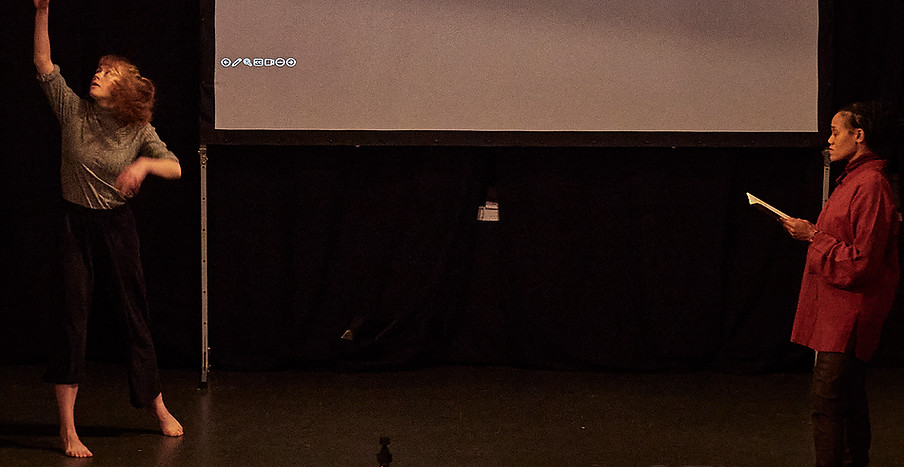
Ellen Jeffrey and Eileen Pun
Next was JR Carpenter, bringing her multimedia piece An Island of Sound to the festival. The work explored phantom islands in the North Atlantic, using found images, algorithmically generated text, sound and live readings to create something that felt like a shifting weather system. The interconnectedness of visuals, soundscape and poetry encouraged a different kind of attention. It made me reflect on my own practice and how important it is to consider every element of a poem, from how it looks to how it feels in the body. Eco poetry often asks us to think in this way, recognising that form, sound and rhythm can echo ecological processes. JR’s simple phrase “Escape. Refuse. Survive” became a powerful call to resilience, resonating not only as a personal message but as an environmental one too. Thinking about how soundscape can become as integral to a piece as line breaks on the page broadened my sense of the tools available to make a poem and showed how poetry can respond to the natural world with both urgency and imagination.

J R Carpenter
Before I knew it, I was attending the penultimate event of the weekend – a wonderful reading given by the Norwich-based TOAST poets, a collective introduced by founder Lewis Buxton. We were treated to readings from Poppy Stevens, Shannon Clinton Copland and Daisy Henwood, in addition to Lewis himself. Their themes ranged from animals to Catholicism to superstitions. Daisy performed a poem that was delightful, reflecting on her brother in surprising ways – ‘my brother is a casserole’. She also read an impactful poem on the physical transformations during pregnancy and beyond – the sharing of cells in creating a new life. Shannon’s intricately woven poems were layered with references, including a nod to Andy Warhol. Poppy had a fresh view on returning home after time away, the complications and joy of relearning a once familiar place. Lewis’s poems, from his new book, Mate Arias published by the Emma Press, were fun and full of heart – the central conceit about finding a best friend. The way he interacts with the audience is effortless and enriches the performance, while also charging the space with warmth and connection.

Lewis Buxton

Daisy Henwood

Shannon Clinton-Copeland

Poppy Stevens
And then there I was, awaiting the final reading of the festival, given by three incredible poets: Roger Robinson, Fiona Benson and Patience Agbabi. Patience’s poetry is deeply evocative and has a fairytale-like quality, with the classic sinister undertones. We then heard from Fiona Benson, with fantastic lines and use of metaphor: “the sky’s being chainsawed open”, “black gummed stubs of teeth”. Her poetry is dark and intricate and made me feel like I was in an apothecary’s shop with countless poisons on expansive shelves. The festival closed with Roger Robinson, a powerhouse of a poet and a captivating performer. One poem in particular which resonated with me was about his mother, and finding faith following her death, a poem heavy with the complications of religion. His set was full of life and joy; from girls celebrating at Carnival, to body positivity, to complex feelings regarding spending time in nature. As sad as I was that the festival was coming to a close, I can’t think of a better way to end it than with these three poets.

Roger Robinson

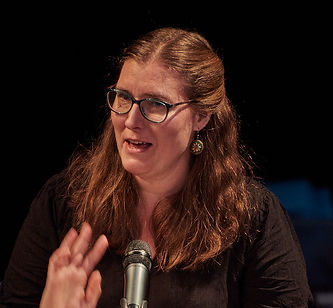
Fiona Benson
Patience Agbabi
Monday 10 November
It is now Monday morning, and I am back home, reflecting on my final day at the festival. Back in the chaos of London and having adjusted to being out of the poetry bubble, I already miss it and particularly the great conversations I had.
It was an absolute honour to be a part of the Poetry in Aldeburgh festival this year, and I have left with so many poems and thoughts. I’ll be digesting all that I saw and experienced for years to come, and I will also be keeping up with all of the poets I heard. Coming into this festival, I felt so welcomed and included by Tamar Yoseloff and the entire committee, so I felt like I belonged. Working and creating collaboratively was a key theme and made me reflect on how poems are not made in a vacuum – they are the culmination of the poet’s interactions, inspirations and experience. I hope to return to Aldeburgh in the future, as this was a dreamy weekend of poetry and connection.
All photos Bill Jackson, except photos of Silva, Piaseki and Gardosi by Jill Abram